Whist
A downloadable game for Windows and macOS
# Whist — The FAQ For A Game That Trusts You With Exactly One Rule
### version 1 — for the trick-taking game that ships without a single meld, wild card, or discard pile
No melds. No wild tiles. No discard pile. No auction. Just a deck, a trump suit revealed by fate (or the dealer's last card), and thirteen rounds of "follow suit if you can." Welcome to Whist — the game Canasta's own rulebook could never survive a crossover with, because there'd be nothing left to steal.
---
## 1. Start Here (the 60-second version)
**What even is this game?**
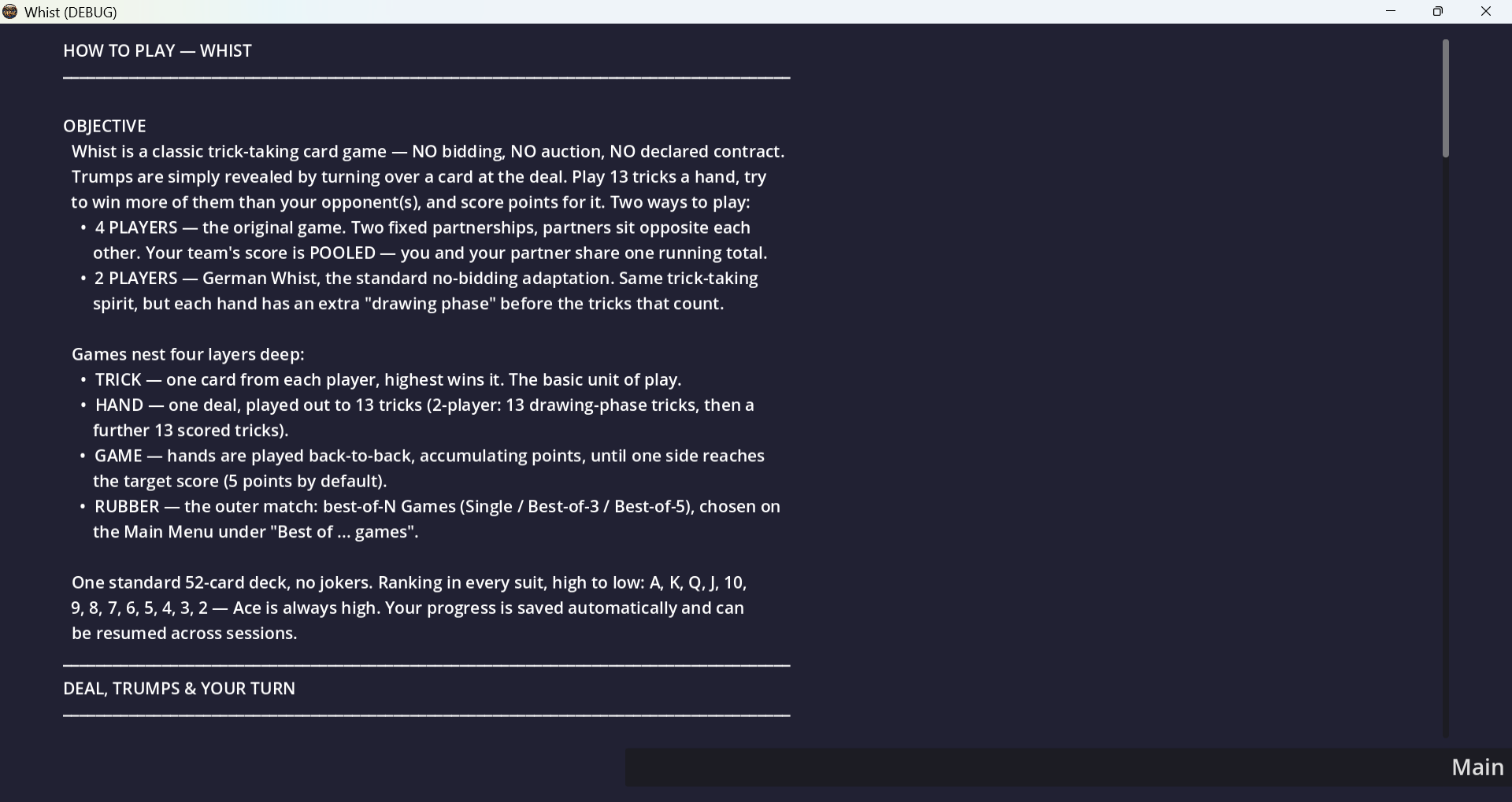
Everyone plays one card per turn, thirteen turns to a Hand, following suit whenever they're able to. Whoever plays the highest card of the suit led wins the trick — unless someone trumped it, in which case the highest trump wins instead. Collect more than 6 tricks (of 13) and your side scores the difference. First to a target score wins the Game; win enough Games and you win the Rubber. That's the whole rulebook. You already know how to play.
**2 players or 4?**
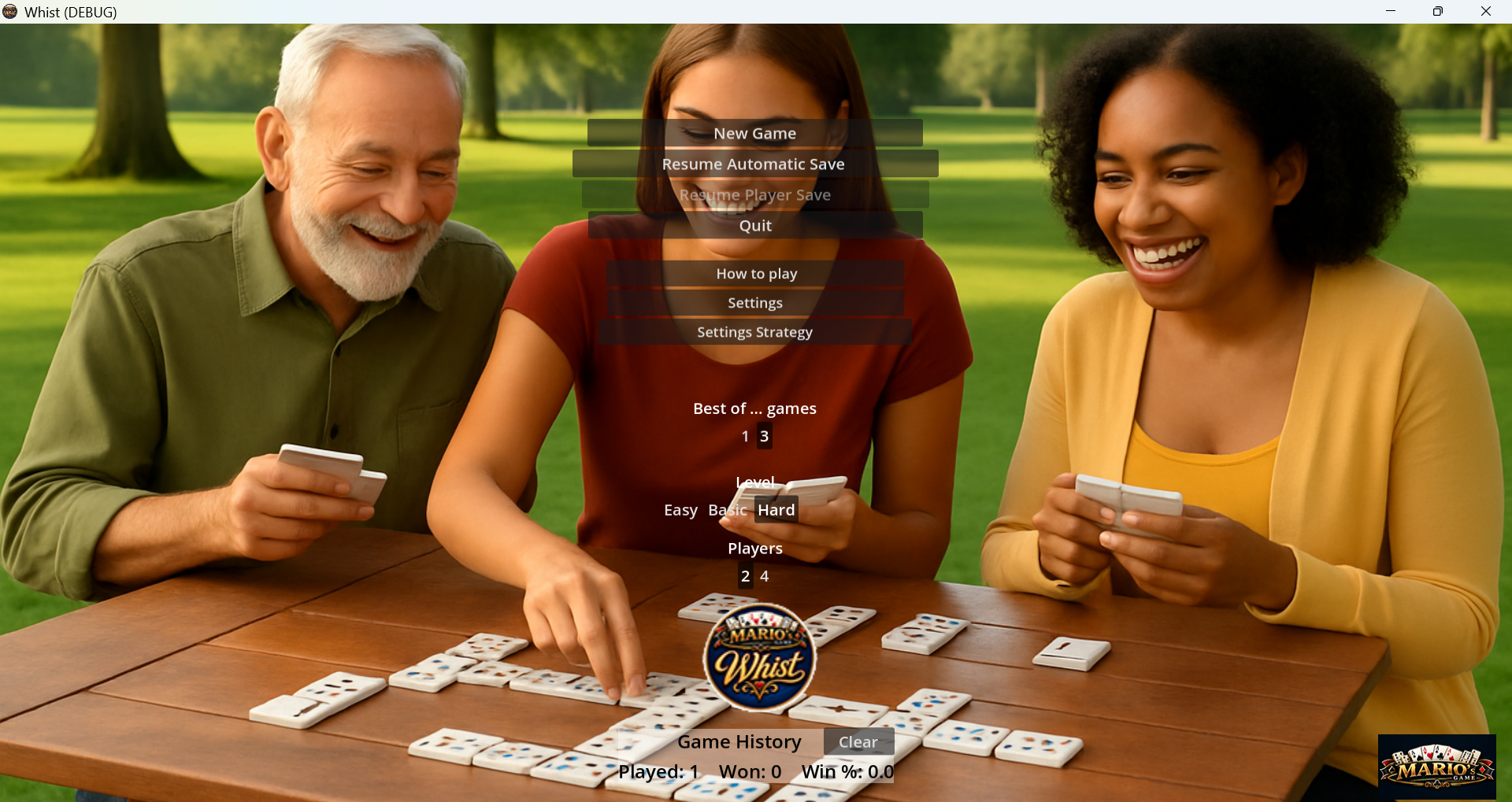
Exactly one of those, chosen from the Main Menu. 4-player is classic partnership Whist. 2-player is German Whist — a genuinely different animal for its first half, see §3 below.
**Who's on my team?**
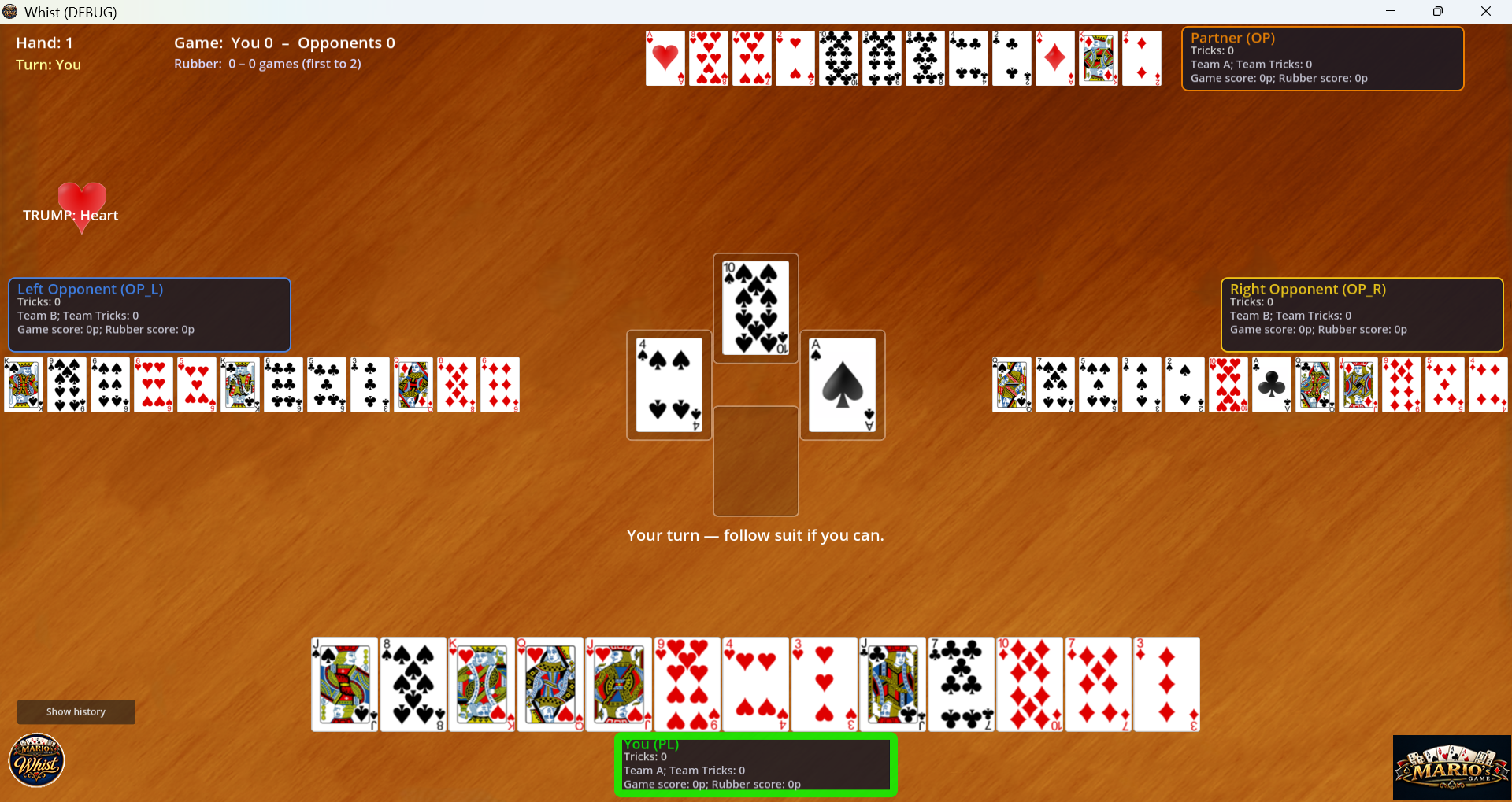
In 4-player: you (PL) and your partner OP sit opposite each other and share one score, facing OP_L and OP_R, who share theirs. Turn order runs PL → OP_L → OP → OP_R, clockwise, forever. In 2-player: nobody's your partner, it's just you (PL) versus OP, alternating leads.
**How do I actually win?**
The session nests exactly like you'd hope:
- **Play** — one card, one seat, one turn.
- **Trick** — every active seat has played once. Highest trump (if any were played) or highest card of the suit led takes it.
- **Hand** — thirteen tricks, start to finish. Trick-points get tallied here.
- **Game** — Hands accumulate points until someone reaches the target score (5 by default).
- **Rubber** — best-of-however-many Games (default: best of 3).
No Loops-within-Loops-within-Loops nonsense — Whist's nesting is refreshingly shallow, mostly because there's nothing to build except tricks.
**Is there an undo?**
No, and there never will be. A Turn is one action — you play a card, it leaves your hand, the trick updates. There's no staging step to cancel out of, because there's nothing to stage. Think before you drop it; this isn't Canasta, there's no "Pick / Play / Drop" dance to interrupt halfway through.
---
## 2. How a Turn Actually Works
**What's the actual legality rule?**
Exactly one, and it's the whole game: if you hold a card of the suit that was led, you must play one. If you don't, play anything — including a trump. That's it. There is no second rule hiding anywhere.
**How does a trick get decided?**
If anyone trumped it, the highest trump played wins, full stop — it doesn't matter how strong the led suit was. If nobody trumped, the highest card of the suit actually led wins. The winner leads the next trick. There's no tiebreak to worry about — every card in the deck is unique, so "highest" always resolves cleanly.
**Where does the trump suit come from?**
Nobody bids for it and nobody chooses it — it's revealed by the deal, differently per variant:
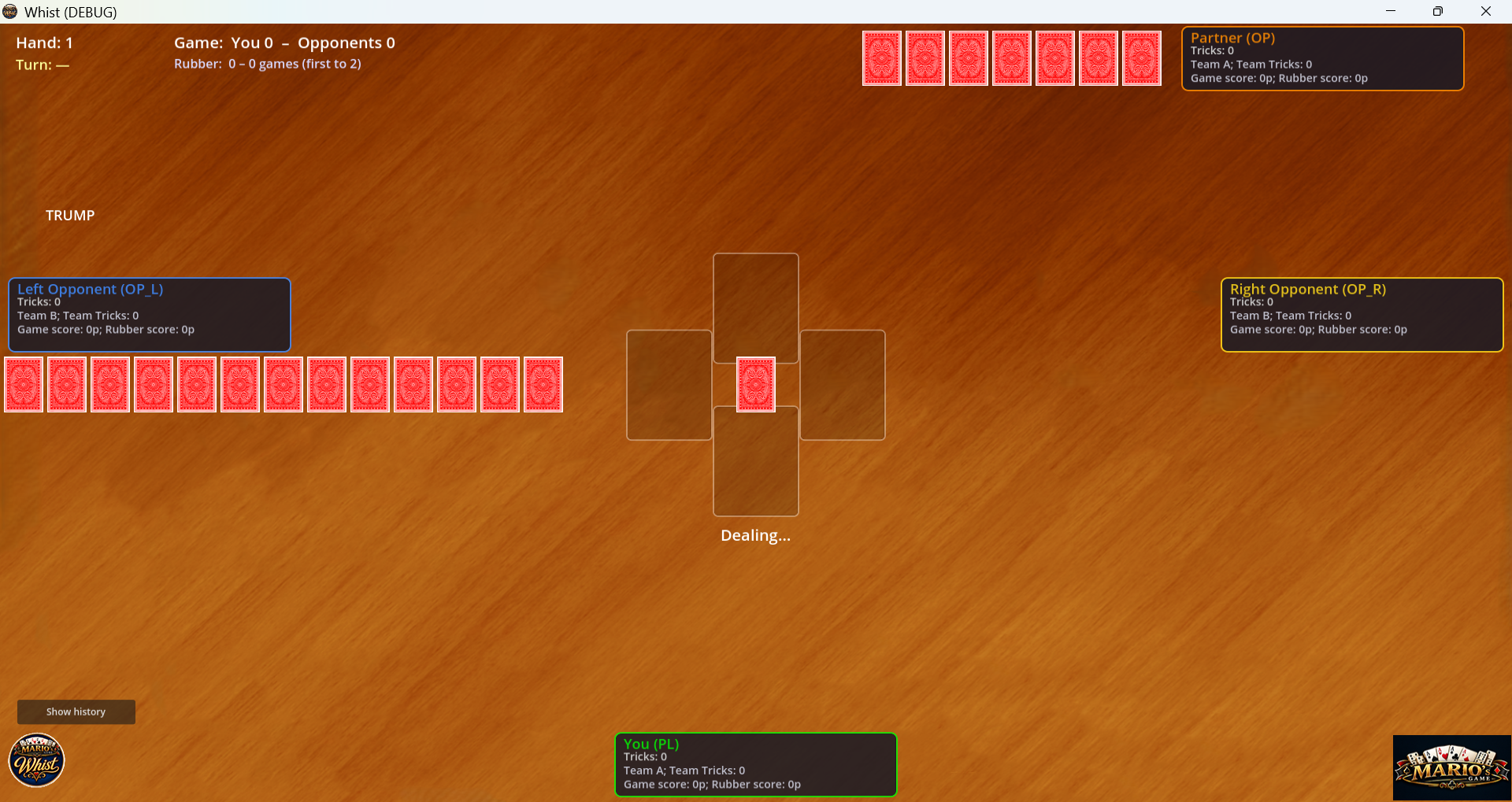
- **4-player:** the dealer's very last card (the 52nd) is turned face-up instead of going into their hand. Its suit is trump for the Hand. It sits there, visible to everyone, until the dealer's first turn — at which point they finally pick it up and their hand goes back to a full 13.
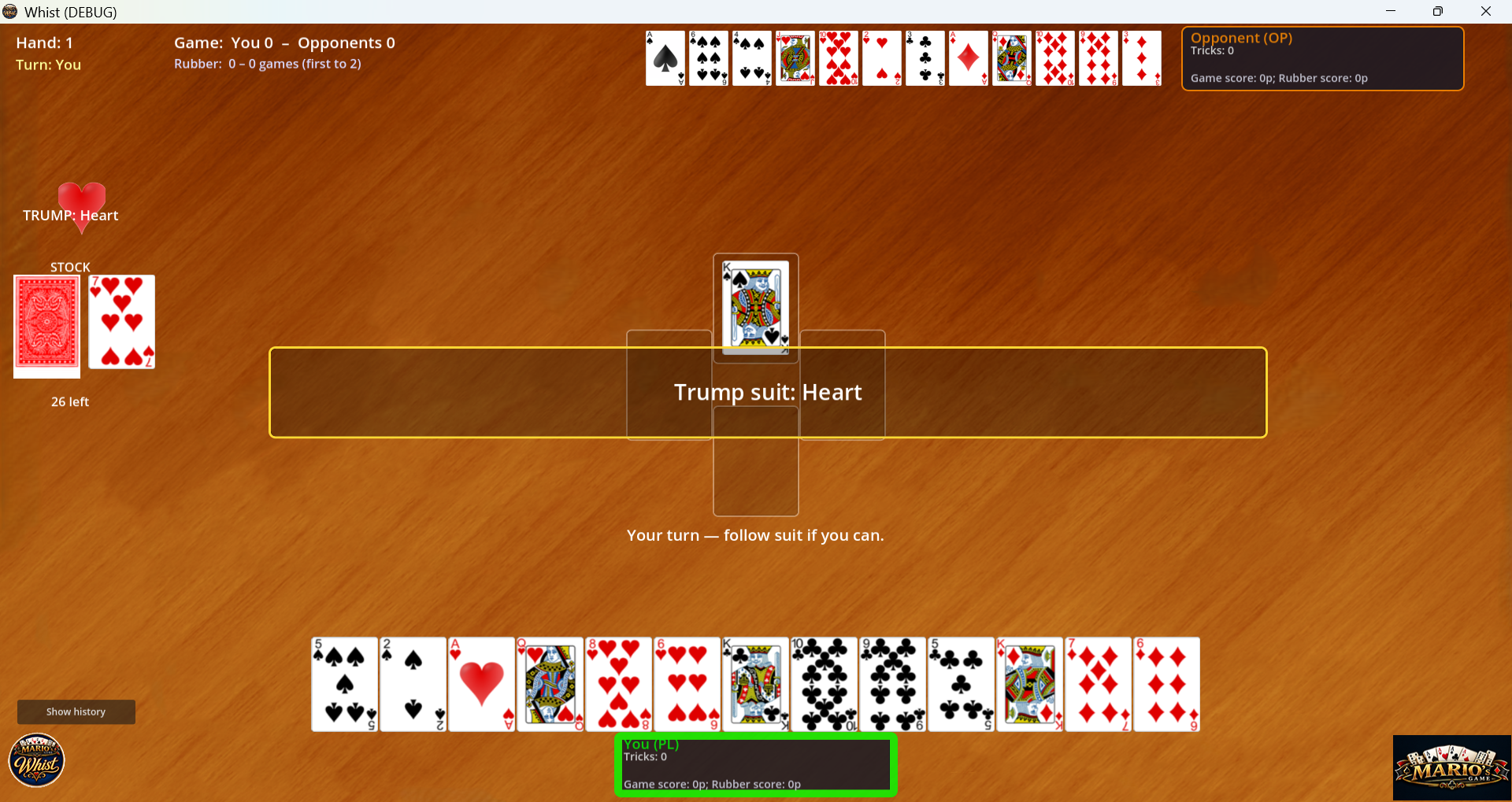
- **2-player:** the top card of the 26-card stock (see §3) is turned face-up and stays sitting there, in plain view, for the entire Hand — both phases. Same rule, different stage.
Ace is always high, there are 13 ranks, one standard 52-card deck, no jokers, ever. If you're looking for an "ace low" toggle, there isn't one — see §8.
**What's the turn order?**
Clockwise, always: PL → OP_L → OP → OP_R → PL in 4-player, PL → OP → PL in 2-player. Whoever wins a trick leads the next one.
---
## 3. The Two-Player Drawing Phase (This Is Not A Bug, This Is German Whist)
If you've only ever played 4-player Whist, this section is where 2-player quietly turns into a different game for a while.
**Wait, what's this "stock" thing?**
2-player Whist deals only 13 cards to each seat — the other 26 sit face-down as the **stock**, with its top card turned face-up as the current trump indicator (see §2). That face-up card isn't just decoration: it's also the prize for the drawing phase you're about to play through.
**So how does the drawing phase actually work?**
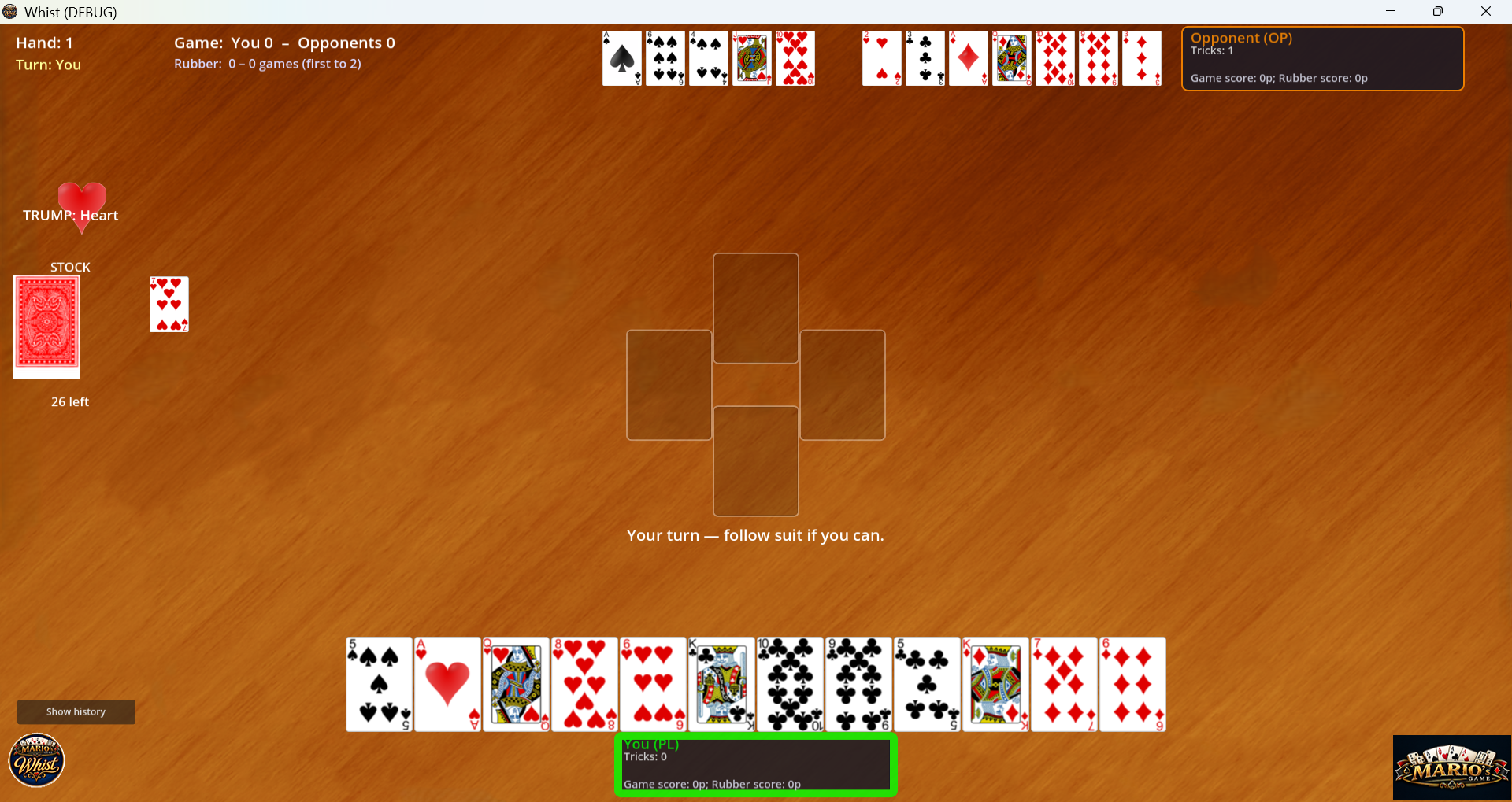
For the first 13 tricks of the Hand (**Phase 1**), after every trick:
1. The trick **winner** takes the face-up card sitting on top of the stock into their hand.
2. The trick **loser** takes the next card of the stock — face-down, unseen until they look — into their hand.
3. Both seats are back to 13 cards.
4. The new top card of the stock turns face-up, becoming the next prize (and the visible trump reference).
Repeat that thirteen times and the stock runs dry. At that point Phase 1 ends and **Phase 2** begins: a completely ordinary, no-stock, 13-trick playout using the hands you just spent Phase 1 assembling.
**Wait — do Phase 1 tricks count for anything?**
No! This is the detail that trips people up the first time: **Phase 1 tricks never score.** Winning one only gets you the good half of the prize (the visible card) instead of a random unseen one — it's a hand-building minigame, not a scoring one. Every point in a 2-player Hand comes exclusively from the 13 Phase 2 tricks. Play Phase 1 like it's a slow-motion draft, not a scramble for points.
**Why would I ever want a low card as the prize, then?**
Because sometimes the best move isn't winning — it's making sure your opponent doesn't get something useful either, or setting up a stronger Phase 2 hand than a "random" unseen stock card would've given you. There's a genuinely deep AI behind this decision on Hard difficulty (a whole category-matrix desire model, no less) — see the [Strategies FAQ](FAQ_Whist_Strategies_v1.md) if you want to know exactly how it thinks, including the one classic trap ("the void trap") that a good player — human or AI — never falls into: leading a low card into a suit your opponent can't follow just *wins* them the card you were trying to deny them.
---
## 4. Trump & Honours
**Does the trump suit matter beyond winning tricks?**
Also this: in 4-player games, you can optionally track **Honours** — the Ace, King, Queen, and Jack of the trump suit specifically. This is a toggle, **off by default**.
**How do Honours actually work?**
They're claimed once, at the end of the Hand, based on the cards your TEAM was *dealt* that Hand — not cards you won in tricks. It's a deal-luck bonus, not a play reward:
- Your team was dealt all 4 honours between your two hands → +4 points.
- Your team was dealt exactly 3 of the 4 → +2 points.
- 2 or fewer → nothing.
There's one guardrail: a team already sitting at the "one point short of winning the Game" mark can't win the Game off an Honours bonus alone — only actual trick-points can close it out. If both trick-points and Honours would finish the Game on the same Hand, trick-points are applied first. (Not available in 2-player — German Whist's constantly-reshuffled hands don't have a clean "what were you dealt" moment to hang the rule on.)
---
## 5. Scoring & Winning
**How many points is a Hand worth?**
Whichever side takes MORE than 6 of the 13 tricks scores (tricks − 6) points; the other side scores 0. Win 9 tricks, score 3. Win exactly 6 (or fewer), score 0. In 2-player, the identical formula applies, but only to the 13 Phase 2 tricks — Phase 1 never contributes a single point, per §3.
Worth knowing: this "tricks-over-6" formula is a **deliberate house choice** for the 2-player variant, not the traditional flat "whoever wins more tricks gets exactly 1 point" some German Whist write-ups use. It doesn't change who wins a Hand (majority of 7+ tricks still wins it) — it just adds a margin-sensitive score on top, the same way 4-player Whist has always worked, so both variants can share one Game/Rubber points system instead of needing two incompatible ones.
**How does a Game end?**
First side to reach the target score (5 by default) wins the Game. Scores reset to 0-0 for the next one.
**How does a Rubber end?**
Best of however many Games you picked — the Main Menu currently offers "Single" (best-of-1) or "Rubber" (best-of-3, and yes, best-of-3 is the traditional Whist default too). Best-of-5 is fully supported under the hood; it's just not one of the two buttons on that particular screen at the moment.
---
## 6. Playing With/Against the AI
**How hard is the AI?**
Easy, Basic, or Hard, chosen from the Main Menu — and each keeps its own completely independent set of strategy toggles and tunables, so cranking Hard up changes nothing about Easy.
**Does it cheat?**
No. It only ever reads what's actually public — its own hand, the trump card, and the full public record of every card played by every seat this Hand. It never looks at anyone's unplayed hand, with one honest exception explained in full in the [Strategies FAQ](FAQ_Whist_Strategies_v1.md): once a 2-player Hand reaches Phase 2, the single opponent's entire hand becomes exactly derivable by simple elimination (52 cards = yours + theirs + everything already played) — that's arithmetic over public information, not a peek.
**What does Hard actually add that Basic doesn't?**
A lot — card counting, reading your partner's tricks correctly, the Finesse and the Expasse, attacking your weak suits, and (2-player only) an entire dedicated drawing-phase brain that decides, card by card, how much the current stock prize is actually worth fighting for. Full breakdown, one tactic at a time, in the Strategies FAQ.
---
## 7. "Do You Have Other Rules?"
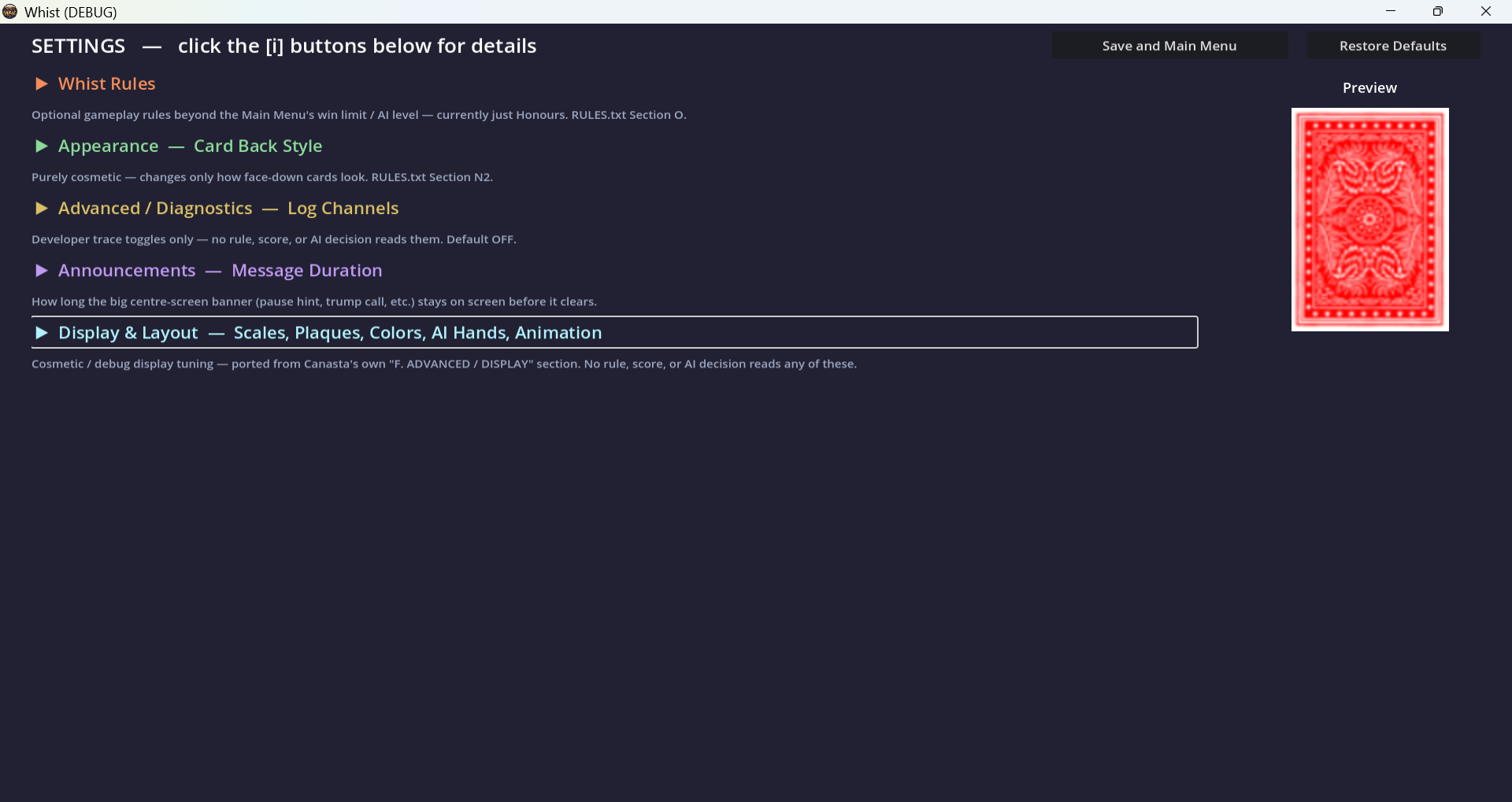
Settings is split into a few honest sections:
- **Whist Rules** — seat count, Game target score, Honours on/off and their point values, card-back style.
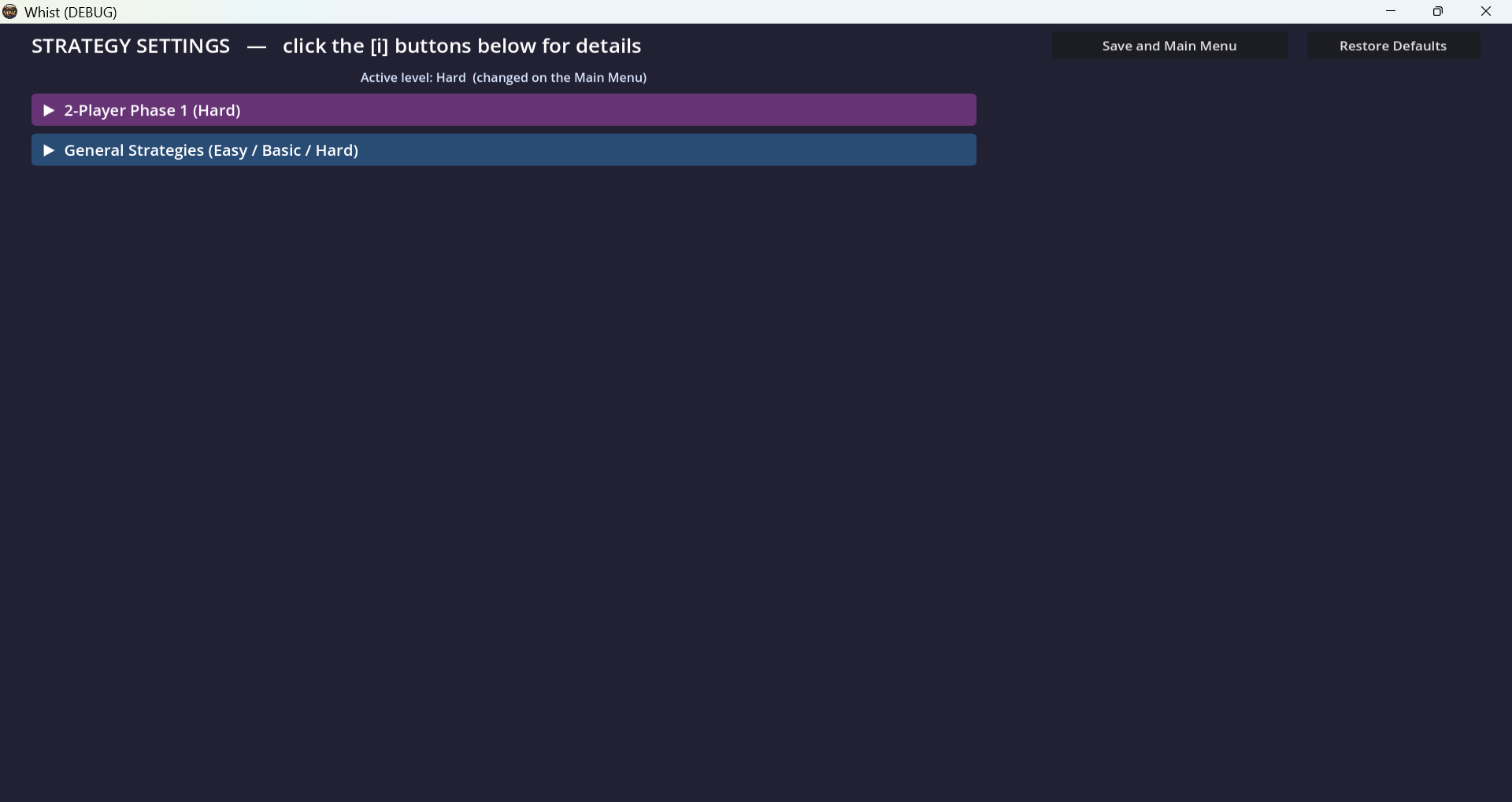
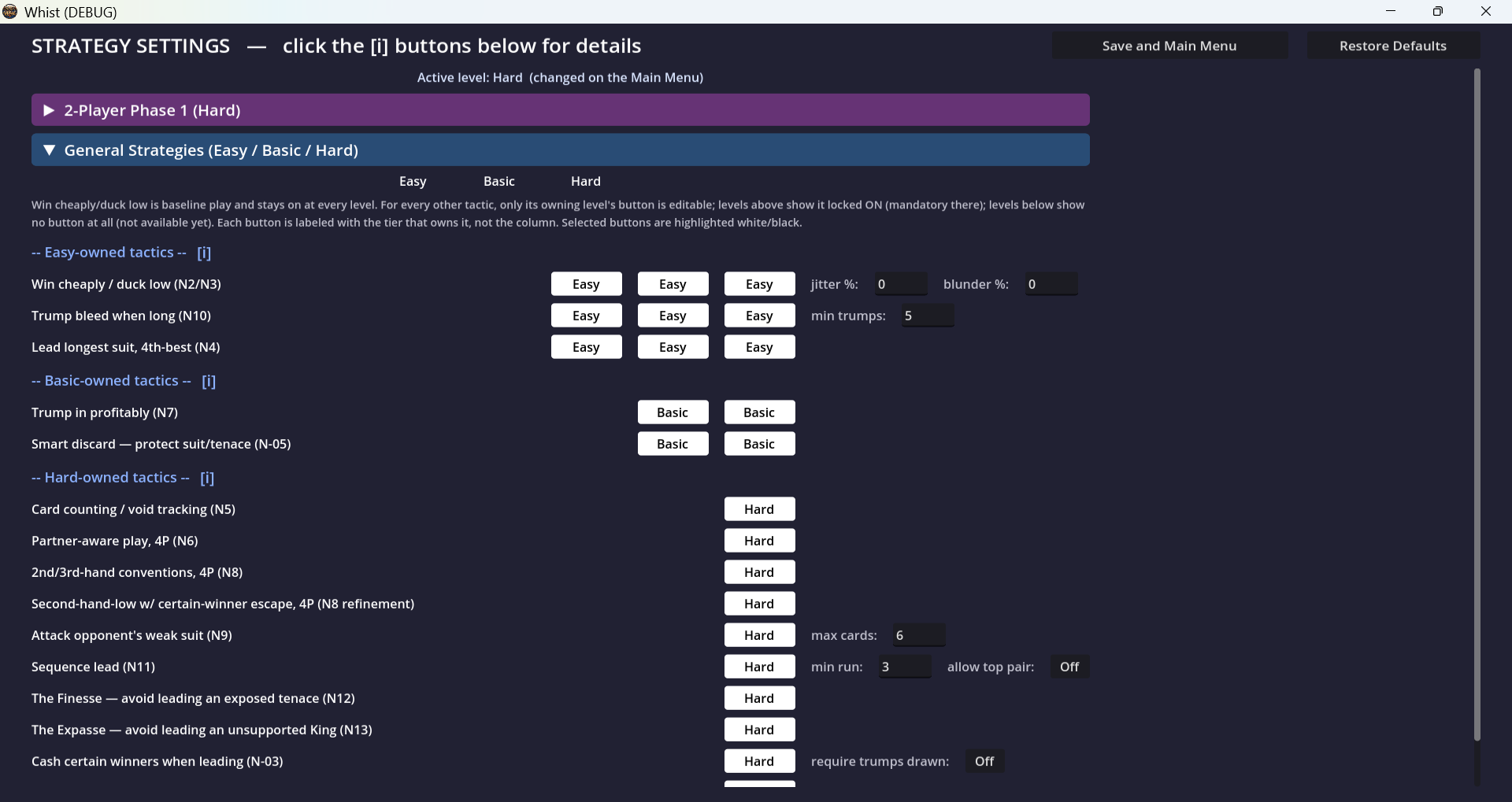
- **Strategy Settings** — the AI's whole brain, now organized into two big collapsible sections: **"2-Player Phase 1 (Hard)"** (the drawing-phase category-matrix model, its own distinct color, up front) and **"General Strategies (Easy / Basic / Hard)"** (everything else, a different color, right behind it). Both start collapsed so the screen isn't a wall of checkboxes the moment you open it.
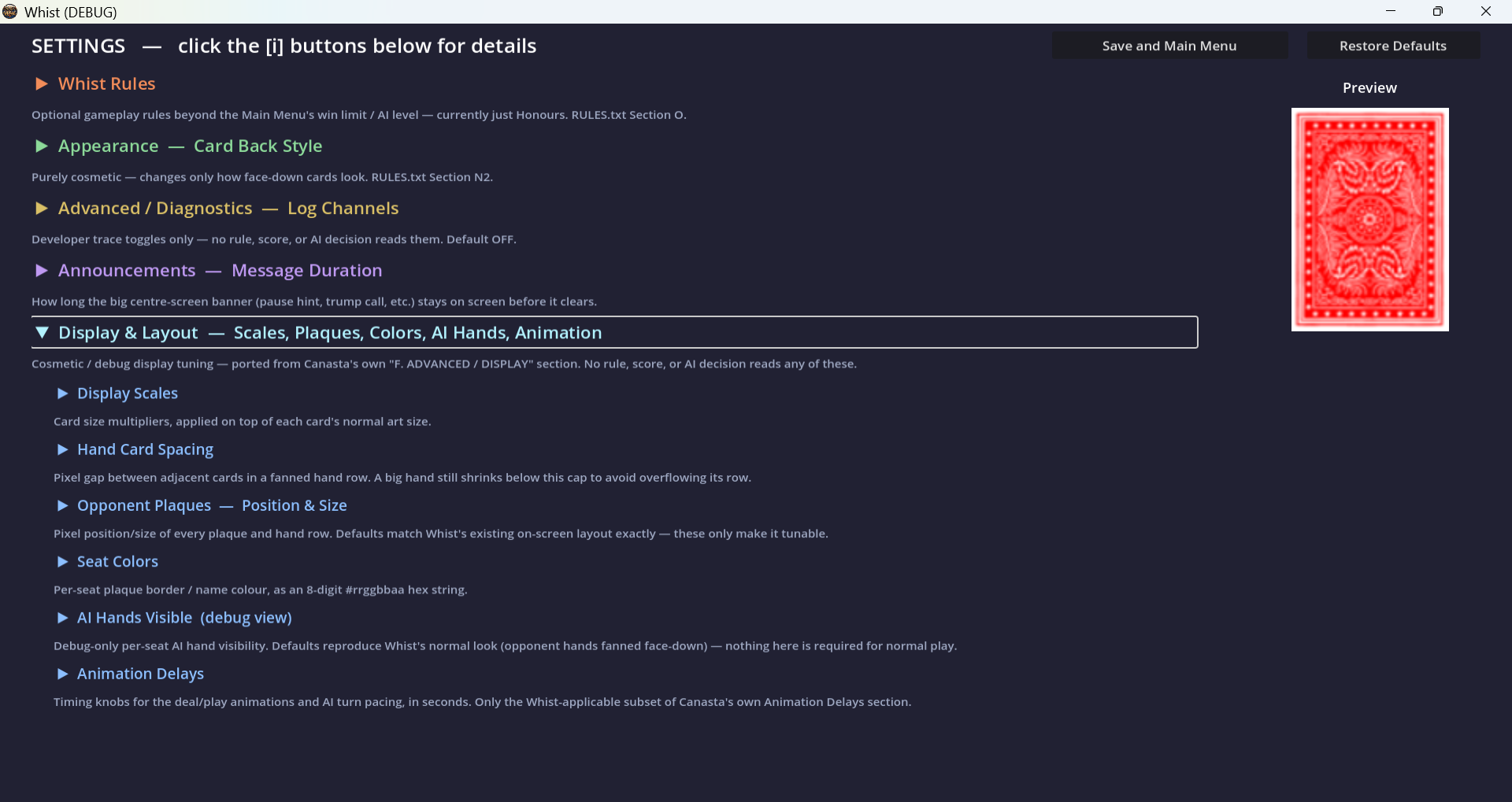
- **Display / Debug** — hand scales, plaque positions, seat colors, whether you can peek at the AI's hands for testing, and six independent debug-log toggles (all off by default).
Full explanation of every single field lives in the [Settings FAQ](FAQ_Whist_Settings_v1.md). "Restore Defaults" exists on both the main Settings screen and the Strategy screen — the Strategy one only ever resets the difficulty level you're currently looking at.
---
## 8. Variants We Deliberately Didn't Build (a short, honest list)
Because "did you consider—" deserves a straight answer instead of silence:
- **Bid Whist / Auction Whist** — no bidding exists anywhere in this build. Trumps are revealed, never fought over.
- **Honeymoon Whist** — the other well-known 2-player variant. It adds jokers and drops the follow-suit requirement during its drawing phase; both of those would break rules this build treats as absolute (no jokers, ever; one follow-suit rule, everywhere). German Whist was chosen instead.
- **Norwegian/Minnesota-style "Two Player Whist"** — bids "high" or "low" games with a largely face-up layout. Also uses bidding, also out of scope, also structurally a pretty different game underneath the shared name.
- **Knockout Whist** — shrinking hands, no partnerships, no fixed per-hand trump. A genuinely different family game wearing the same name.
- **Ace-low mode** — doesn't exist. Ace is always the highest card, full stop.
- **3-player Whist** — the partnership structure doesn't divide onto an odd seat count, and nothing in this build tries to make it.
- **A full Canasta-style, every-field-gets-a-help-popup Settings encyclopedia** — not because Whist's settings don't deserve documentation (that's what this FAQ and its two companions are for), but because a much leaner in-app Settings screen was the actual build choice.
---
## 9. Practical Nonsense
**Is my progress saved?**
Yes, and it's split into two genuinely independent slots: an automatic checkpoint that updates on its own as you play, and your own explicit save from the ESC pause menu ("Save & Exit" / "Save & Quit"). The automatic one will never overwrite your manual save, and vice versa.
**Everything's moving too slowly and I'm testing a dozen Hands in a row.**
Settings → Display / Debug → Animation Delays. Every `anim_*` value set to 0 makes that step instant — AI turns, deals, the 2-player stock draw animation, all of it.
**I turned on a debug log — where does it go?**
Six independent toggles (`log_do` through `log6_do`), all off by default. Flip one on and it starts writing to your saved-games folder; flip it back off and it stops.
**I found a bug.**
Every trick-taking game has a few. Report it, and in the meantime, blame the trump card — it's traditional, and unlike most Whist superstitions, this one's actually true about half the time.
---
*Whist — where the entire rulebook fits on one side of an index card, and the other side is just people arguing about whether you should've led your last trump sooner.*
Download
Click download now to get access to the following files:
Leave a comment
Log in with itch.io to leave a comment.